


How acron is Transforming Monitoring and Reporting at Berliner Wasserbetriebe
First-Hand Insights
(A summary of an interview with the technical team at Berliner Wasserbetriebe)
Berliner Wasserbetriebe (or BWB) is more than just a water supplier. It is one of the largest players in Germany’s water industry, serving over 3.7 million people in Berlin and the surrounding areas, and treating wastewater for an additional ~3.9 million residents.
With more than 170 years of history, around 4,200 employees, and ongoing innovation — including in digital infrastructure — the company continuously invests in modernization.
Thanks to acron, the company’s reporting system has been significantly improved
PREVIOUSLY
A single SCADA server, manual data validation, and constant time constraints.
NOW
A centralized source of validated data, accessible to engineers without involving IT specialists.
The project in numbers
Around 22 technical sites
Currently over 10,000 active measurement points
Around 13,000 tags expected in the final configuration
The product in use
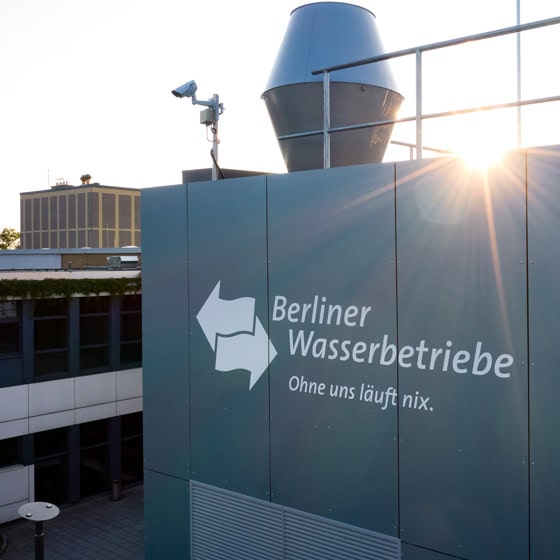
Foto: Waterworks Tegel | © Berliner Wasserbetriebe
Scale, Distribution, and Data Validation
The Berlin challenge
There are around 22 technical sites across Berlin, distributed throughout the city. These facilities currently handle over 10,000 active measurement points — with 13,000 tags expected in the final configuration.
Previously, BWB used only one process control system for reporting. This created a bottleneck: generating a report meant manually collecting data from various sources — often in Excel files or handwritten notes. All data had to be manually verified. This slowed down operations and introduced the risk of basing decisions on outdated or incomplete information.
This challenge prompted Berliner Wasserbetriebe to search for a full-fledged historian system — with automated data collection, validation, calculation, and reporting.
acron: Everything in one system
Searching for a solution
The team tested several products, but only acron was able to meet all requirements in one package – fully integrated into one system, with no need for additional software.
WHAT IS NEEDED |
» |
HOW ACRON SOLVES IT |
| Collect raw data from PLCs at all locations | » | Drivers for most industrial protocols |
| Compression and archiving | » | Built-in data compression algorithm saves disk space and speeds up processing |
| Validation and correction | » | A separate logic layer before writing to the database |
| Trend graphs | » | Built-in visualization and analytics tools |
| PDF/Excel reports | » | Report generator with charts and formula support |
| Export to external systems | » | Direct export to .xlsx, OPC UA, REST |
Flexibility and openness
A look at the process
Data where it’s needed
acron made data truly accessible. Previously, requests had to go through engineers. Now, the data can be exported, processed, visualized, or integrated into other systems — even by non-IT staff.
The company has opened up data access for those who need it most: analysts, engineers, and decision-makers.
HOW THE PROCESS WORKS
- Automatic and precise data collection from field devices.
- Transmission through several processing stages to a central server.
- Analysis and report generation using acron.
- Publication of reports on the internal company portal.

Foto: Wastewater treatment | © Berliner Wasserbetriebe
Want to see what this looks like in practice?
This article is based on a video report by the technical team at Berliner Wasserbetriebe, which already uses acron in its ongoing operations.

Foto: Aerial view Tegel-Schoenerlinde | © Berliner Wasserbetriebe
Expanding data coverage
Looking ahead
The team is evaluating how to automate data collection for parameters that are still gathered manually — such as over 300 pressure monitoring points. Automating this process will relieve staff from routine manual readings, make operators’ work easier, and improve data accuracy.
acron is now used not only in waterworks but also in sales departments and other companies within the group.
The system is scalable: if the organization decides to unify all reporting and transition to a single analytics format, acron is the tool that can support this standardization.